
Biological Programs
How Our Bodies Best Efforts Get Mistaken for Disease

Our cuts heal of their own accord. Our bodies adjust production and content of secretions without consultation. Our babies receive the necessaries—all without our conscious awareness. Thank goodness for these biological “programs,” presumably evolutionary gifts from before our pre-frontal-cortex days.
But sometimes these unconscious programs get interrupted—and then mistaken for disease. So it can be vitally important to learn to distinguish and resolve a subconscious imperative, rather than continue to fight the body’s good intentions.
A recent case illustrates this point beautifully. A client I’ll call Amanda came with the goal of resolving a cyst that had grown on her neck. Doctors had previously examined it and found it to be slow-growing, but advised her to excise it. Her good instincts had told her to simply wait, which she had been doing for the past ten years. Now she wanted to try to resolve it with Resonant Attention.
Upon inspection, I noticed that this cyst was subtly communicating with her “uterus,” trying to resolve a trauma from 27 years old. That turned out to be the age that Amanda had suffered a Caesarean section while birthing her son. The trauma had been extreme and resulted in decades of exhaustion.
“I just never recovered from it,” Amanda explained.
Note that “uterus” is in quotations up there because, after the birth, Amanda had developed terrible fibroids that had eventually led to a total hysterectomy. Nevertheless, the energetic structures were still palpable. (Scientist Robert Becker’s The Body Electric is a fascinating exploration of the subtle templates.)
In that first session, we simply held attention and allowance on this connection. Miraculously, Amanda’s cyst started to grow in the week that followed, becoming swollen and red. Amanda was alarmed, but believed that her body had finally begun to resolve the trauma from her C-section and so was willing to continue.
When I saw her next, her body had moved on and seemed no longer to be processing the cyst. This relieved my concerns that Amanda’s symptoms were the result of a looping nervous system. Change is a good marker that at least one layer of trauma has been resolved.
In that session, we attended to the lower nerve roots, which seemed to be actively innervating her “uterus,” as a body might do towards the end of pregnancy. In the weeks following that session, Amanda’s cyst began to suppurate. She eventually went with her husband to a doctor to drain the cyst.
“But it wasn’t just a normal draining,” Amanda explained. “The wound began to pulse as if I were giving birth. There was even a period at the end that was like a delivery of the umbilical cord, in which the slough (the dead skill cells within the cyst) came out.”
As she was telling me her story, Amanda was making connections she hadn’t put together before. She realized that her experience was archetypally completing the program her body began to create a child—but that had been severed and confused by the C-section. Now we were able to surmise that the fibroids had been the result of this incomplete program seeking still to nourish something, anything. And when the uterus had been cut out, the cyst had grown instead of the fibroids.
At the end of our session, Amanda’s body seemed spent, as if she had finally stopped outputting the great amount of energy needed to nourish a child. “All I want to do now is cancel all my busy-ness and tend my garden, like I never did with my baby because I thought I had to go right back to work,” Amanda exclaimed.
I encouraged this strenuously, advising her to even go so far as to employ the post-partum recommendations in The First Forty Days by Heng Ou and my dear friend Amely Greeven. The end of a program to nourish a child—even if it comes thirty years late—is a good opportunity to reset the mother’s baseline.
Love,
Stella
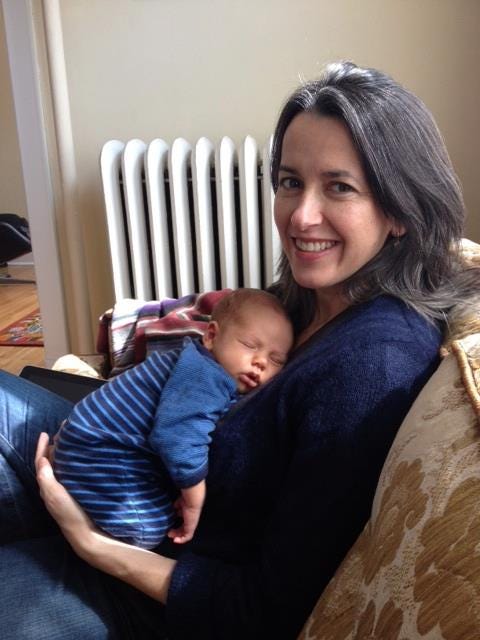
My god, you're beautiful! Unbelievable that you're 42 holding that little boy. Wow. Just, wow.
LOVE the picture.
And the creative brilliance of the body as you have written.
Thanks.